
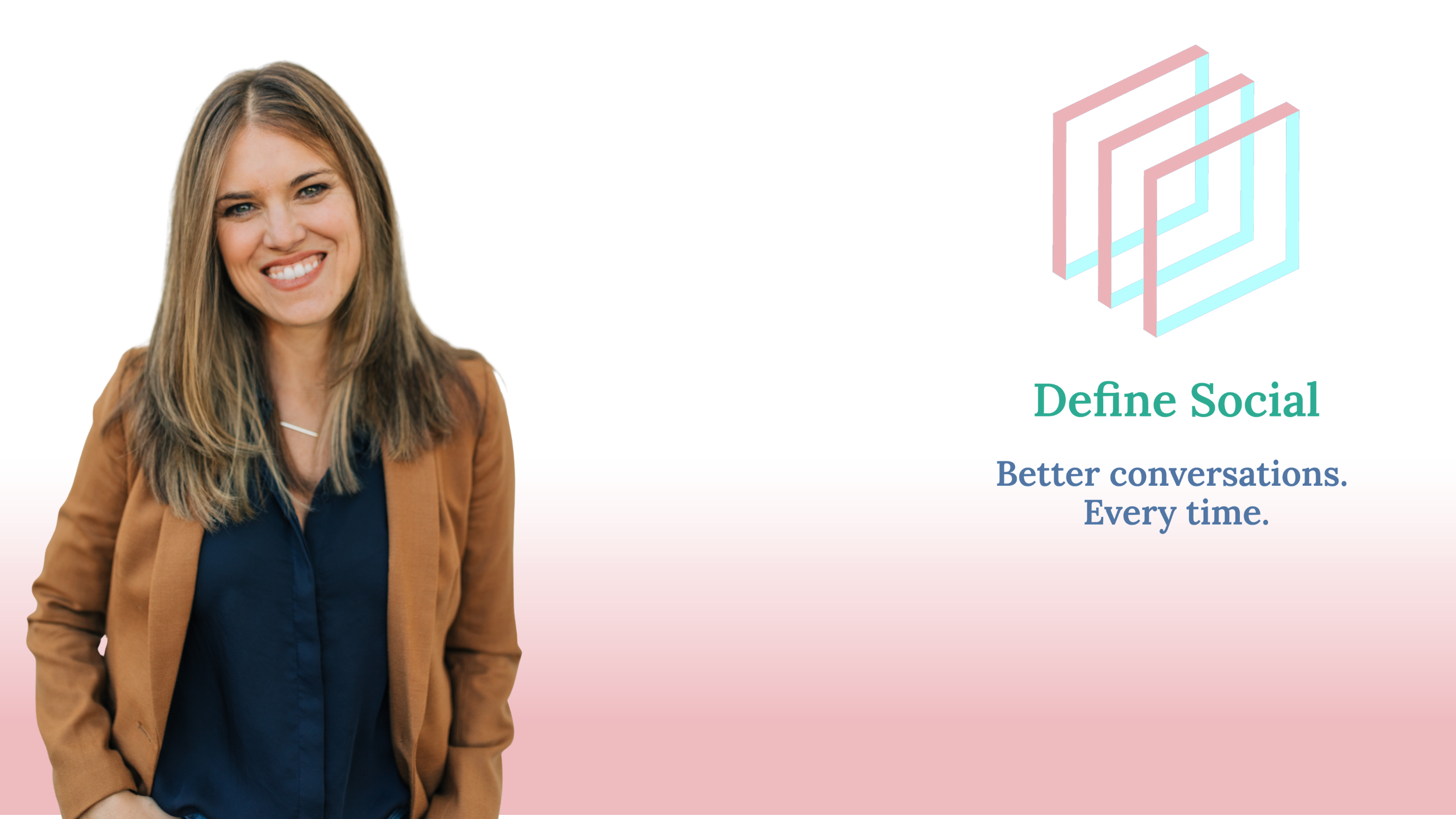
Candace Chapman is the founder of Define Social, a startup built on the conviction that deep connection and conversations don't happen by accident. A former CPA turned community developer, her career has spanned public accounting at a Big Four accounting firm, corporate finance for a Fortune 500 company, and over a decade of economic development work for communities across the country. She holds a Bachelor’s in Accounting and Entrepreneurship and a Master's in Community and Economic Development, and has lived and worked in London, England Chicago, IL, Charlotte, NC, Evansville, IN, and Denver, CO. She is building Define Social through a stack of AI tools, between school pickup and dinner.
A Conversation with Candace Chapman
WWC: Tell us about the various roles and responsibilities that comprise your calling.
The through-line in my life is a conviction that God created us for deep connection with people and places. That thread has run through everything: starting as a CPA at PwC (formerly PricewaterhouseCoopers), moving into corporate finance, then city-building, and now pursuing how tech can help us foster deeper connection, rather than relational isolation.
For the past decade, I've worked towards helping neglected spaces redevelop into vibrant, connected places, securing over $100 million in public and private investment for downtown revitalization and community projects. Most recently, I've done this work as Associate Director at JLP+D, where we've helped public, private, and nonprofit clients build better cities, from daunting economics through final implementation.
Now, thanks in large part to AI, I've created a startup that I've been dreaming about launching since 2018. Define Social grew out of my convictions about the need for connection. Deep connection doesn't happen by accident, and I believed something could be built to help us get back to more intentional conversations, starting with the relationships right in front of us. For women today, the weight of work and family life is real, and meaningful connections often get deprioritized. Life just fills up. And yet deep conversations–with our spouses, our family, our friends–are some of the most life-giving opportunities available to us.
WWC: You recently launched Define Social. What is it? What problem does it work to solve?
Define Social is a phone-based app that was built for a feeling most of us know: you love the people in your life, but the conversations that actually matter keep getting bumped out by the business (and busyness) of life.
We spend so much time on logistics. Schedules, bills, commuting, the kids, what's for dinner. The conversations that led to love, or that make a friendship feel grounded, gradually get squeezed out. You're not struggling…you're busy. And the people closest to you accidentally get deprioritized. That gap between the connection we’re made for and the connection we experience is a holy discontent for me, and led to me creating Define Social. Define Social reprioritizes these conversations and makes them easier.Here’s how it works:
Two people login to Define Social and answer prompts privately, set their depth preference for the conversation, and then a page called the Common Ground Reveal surfaces at the time you set before you meet. The Reveal shows each of you the topics that are top of mind for both of you, keeps everything else private, and hands you a real, in-person conversation to have with each other - the kind that doesn't happen on a screen. We're also building ways for groups of people to use the app to think through what they want to cover together. Our hope is that no one walks away from a conversation having overlooked an important topic or regretting that they didn’t ask that one question.
WWC: How did you discern God inviting you into this new venture? What did obedience look like in that moment?
It wasn't a dramatic moment of calling, but rather a persistent conviction. The need was so clear to me. I saw it in my own marriage, in my friendships, in the subtle drift that happens to good people in good relationships when good things accidentally crowd out intentionality. I knew something could be built to help. I think that's what the organization Praxis Labs calls redemptive imagination–seeing something that needs to be put right, being unable to stop seeing it, and carrying the sense that you might be a person who could help put it right.
For years, I kept having small doors crack open and then quickly close, and I'd wonder why God had given me such a clear sense of the problem without a clear path to the solution. The obedience, when it finally came, looked less like a dramatic step of faith and more like stewardship: when AI tools finally made it possible for someone like me to build this, I recognized it as the opportunity to see what could be. I think sometimes God doesn't change the vision, but He makes us learn to be patient until circumstances change.
WWC: The process of bringing Define Social to market stretched over several years. How did you maintain your enthusiasm for the project in the face of setbacks and delays? How has God grown your faith through this experience?
I thought about and talked about this idea for eight years with very little forward movement. For an Enneagram 3, that's an uncomfortable place to sit for a long time.
What kept me going wasn't enthusiasm. Enthusiasm comes and goes. Rather, the pain points in my own life as a busy career-minded wife, mom, and friend never eased. I've learned to treat a persistent conviction as a divine prompt worth paying attention to.
Now that I'm building and marketing the app daily, a new kind of challenge has shown up: the daily experience of excitement and frustration, running into confusion, feeling disappointed, and not always knowing the next right thing. I pray daily that God would be the one leading, that the apps growth would move at the right pace, and that it would become available to the people who need it most. I'm learning what it means to hold a vision loosely while working hard toward it, and to define success as faithfulness, not just outcomes. That's a lot of rewiring for me.
WWC: At a time when many smartphone users try to reduce their screen time, you invite Define Social users to pick up their phones. How have you seen this form of technology enrich lives?
The screen time concern is real, and it's mostly about passive consumption: scrolling, comparing, disappearing into content that doesn't give anything back. Define Social is the opposite of that. It asks you to be present and intentional for a few minutes, and then it hands you a real conversation to have with the person sitting next to you. The phone is only the tool to get you there. What matters is what happens after you put it down.
I've heard from couples who said they talked for two hours after a Define Social session, discussing things they wouldn't have normally brought up. That's not screen time. That's the phone doing what it is capable of doing: connecting people, not isolating them. Technology isn't necessarily the problem. Passivity is.
WWC: Artificial intelligence was instrumental in supporting the app design and marketing process. What encouragement would you have for women who hesitate to incorporate AI into their lives or work? What cautions can help us navigate the new technology wisely?
I am not an engineer. I don't write code. But I was able to build Define Social with a few hundred dollars of AI tools, between school pickup and dinner. I say that not to be impressive but to be honest: the barrier is lower than most people think, and waiting until you feel ready is exactly how the digital technology gap gets wider.
So much of the conversation about AI focuses on what it might take away. What I've seen is (when used deliberately) AI has a lot to give: knowledge, access, and agency to people who could never have directly built solutions before. I couldn't have gotten Define Social into the world without it. That matters to me, not just as a founder, but because I believe God gives us minds to use and problems worth solving. AI is a tool that lets more people actually do that.
I don't want to minimize the questions or concerns AI brings. They're very real. Innovation has always brought with it new challenges that we have to overcome. As Christians, we have a God-given responsibility to steward our resources (time, money, and environment, to name a few) to bring a little bit of heaven to earth. This is one of those opportunities.
Zooming back into practicalities: My encouragement is to start with one small thing, a task you already do, made faster. Curiosity is enough to begin. The tools I've found most useful in building Define Social are Claude, Lovable, and Wispr Flow. In my personal life, Gemini has been a lifesaver. Allie K. Miller has also been a thoughtful voice on AI literacy for women whom I’ve been following.
My caution is this: stay the author of your own work. AI is a collaborator, not a replacement for your judgment, your voice, or your values. Know what you believe, and use these tools to move further and faster in that direction. If you have questions or want to talk through where to start, I'd genuinely love to help. Reach me at candace@definesocial.app.